
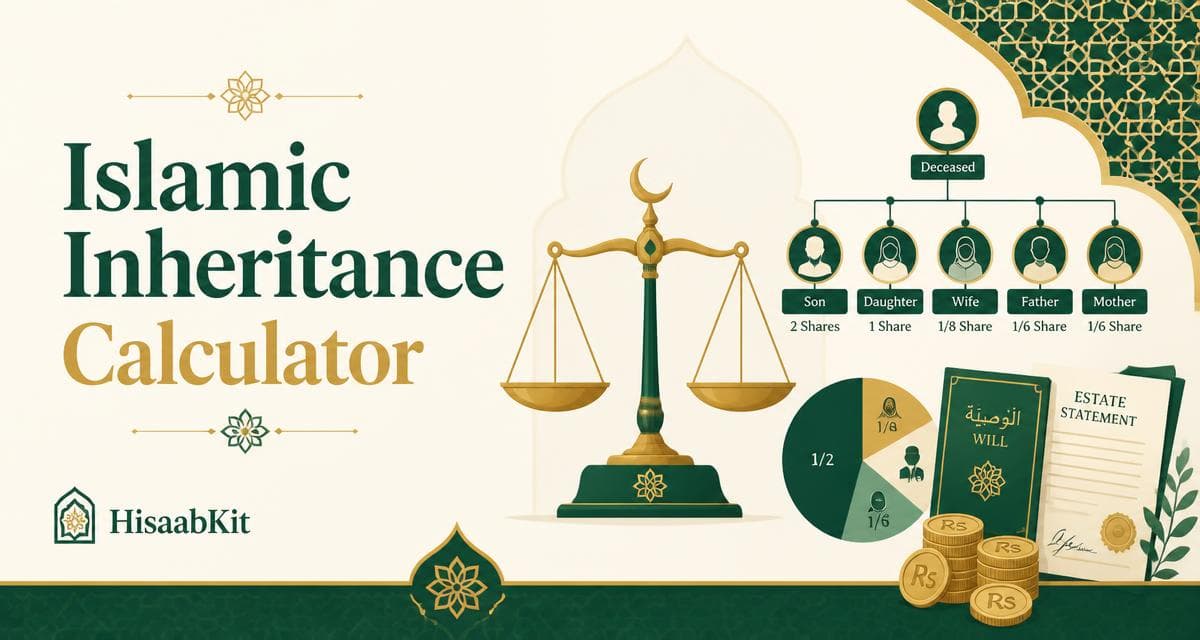
About this Islamic Inheritance Calculator
This Islamic inheritance calculator, also called a Faraid calculator, follows the supplied common Sunni sequence: settle the estate, identify eligible heirs, apply fixed shares, and distribute any remaining balance to residuary heirs according to priority. This version applies one configured Faraid calculation model to the supported heir combinations. It does not calculate or compare differences among Hanafi, Shafi'i, Maliki and Hanbali jurisprudence.
What Can This Islamic Inheritance Calculator Calculate?
This calculator can help estimate:
- Islamic inheritance shares for eligible heirs
- Faraid fixed shares
- Residuary (Asabah) shares
- Heir blocking rules
- Distribution after applicable estate deductions
- Each heir's estimated share, percentage and amount
- Property or estate distribution in Pakistani rupees
- One configured Faraid calculation model for supported heir combinations
Who Can Use This Islamic Inheritance Calculator?
This calculator can help families, property owners and individuals understand a general Islamic inheritance distribution based on the surviving heirs entered. It can be used for estates involving property, cash or other assets that need to be reviewed under Islamic inheritance rules.
The result is an educational estimate, not a final religious or legal determination. Verify an actual estate settlement with a qualified Islamic scholar and, where required, the relevant legal authority in Pakistan.
What Information Do You Need?
To calculate an estimated Islamic inheritance distribution, prepare the total estate value, applicable estate deductions and details of the surviving heirs, such as a spouse, parents, sons, daughters and other eligible relatives.
How to Use This Islamic Inheritance Calculator
- Enter the gross estate value and any funeral expenses or enforceable debts.
- Enter a permitted bequest only when it applies, then confirm the bequest condition.
- Confirm the listed heirs and enter the number of surviving relatives in each relevant category.
- If applicable, select the unborn-child scenario and enter the surviving family structure carefully.
- Select Calculate inheritance to review the distributable estate, fixed shares, residuary share, blocked heirs and estimated amounts.
How Is Islamic Inheritance Calculated?
Islamic inheritance is calculated by first determining the net estate after applicable deductions and then identifying the heirs who are entitled to inherit. Fixed Faraid shares are assigned first, followed by any remaining share for eligible residuary heirs. The exact distribution depends on which heirs are alive at the time of death.
Islamic inheritance, or Faraid, uses prescribed shares for certain heirs. The final distribution depends on the surviving family members and the rules that determine which heirs inherit and which heirs are blocked. This is why the same estate can produce different shares depending on the family structure.
HisaabKit provides a general calculation using one configured model. For an actual inheritance settlement, the result should be reviewed by a qualified Islamic scholar and, where required, the relevant legal authority in Pakistan.
What Is Deducted Before Islamic Inheritance Distribution?
Funeral and burial expenses and enforceable debts are entered before the inheritance shares. Depending on the circumstances, the deductions may include funeral expenses, valid debts and a valid bequest within the applicable limits. A valid wasiyyah is limited to one third of the net estate after those amounts and is treated here as permitted only when it is for a non-heir or has the required heirs' consent.
Which estate value should you enter?
Enter only the property and assets legally and beneficially owned by the deceased. For a jointly owned house, land, bank account or business, enter only the deceased's verified ownership share—not the full value of the jointly owned asset.
Before distribution, confirm funeral and burial expenses, enforceable debts, ownership disputes and any valid bequest. Gifts completed during the deceased's lifetime, nominee arrangements, disputed transfers and jointly held assets may require separate legal and scholarly review.
How Are Faraid Shares, Residuary Heirs and Blocking Applied?
Spouses, parents and some daughters or sisters may receive fixed Quranic shares. Sons, brothers and other male agnate relatives may receive the residue, while a daughter or sister can share as a residuary alongside a son or brother of the same degree. A closer relative can block a more distant relative, so the same estate amount can produce a different result for each family.
Which Surviving Heirs Can Be Entered?
The form covers husband, wives, biological sons and daughters, descendants through sons, parents, paternal grandfather, full, paternal and maternal siblings, nephews, paternal uncles and cousins. Grandmother shares are not calculated in this version. Adopted, step- and non-biological relatives are not counted in these standard heir categories. Non-Muslim relatives may be considered for a bequest rather than an inheritance share.
When this calculator should not be used alone
Specialist review is required where an estate involves a paternal or maternal grandmother, a missing heir, disputed marriage or lineage, disputed ownership, jointly owned assets whose share is uncertain, adopted or stepchildren, a predeceased child's descendants, an unborn child where the final sex or status is not yet known, non-Muslim relatives, an heir whose eligibility is disputed, different jurisprudential treatment, court proceedings or contested succession.
Enter only heirs who were alive and eligible at the relevant time. Biological sons and daughters are the child categories supported. Adopted and stepchildren are not automatically converted into biological heirs by this calculator. A nominee is not automatically treated as the beneficial owner of an asset. Pregnancy scenarios are estimates only and must be recalculated after the relevant facts are confirmed.
How Is a Father's Property Divided in Islam?
When a father dies, his property does not automatically go entirely to his sons or daughters. The estate is distributed among the surviving heirs according to Islamic inheritance rules. The father's surviving spouse, parents, sons, daughters and other eligible heirs may affect the final shares.
Enter the surviving heirs in the calculator to estimate the distribution. The exact share depends on the complete family structure and the applicable rules.
Zakat on an inherited share
An inheritance share can become part of the recipient's own zakatable wealth. Once the recipient holds qualifying wealth above Nisab for a complete lunar year, use the HisaabKit Zakat Calculator to review the separate 2.5% calculation.
Calculate Zakat on inherited shareIslamic inheritance calculation examples
Wife, son and daughter
Inputs: gross estate Rs 2,400,000; funeral expenses Rs 0; debts Rs 0; bequest Rs 0; one wife, one son and one daughter; all other heirs 0; no unborn child.
- Distributable estate:
- Rs 2,400,000
- Wives: 12.5% — Rs 300,000
- Sons: 58.33% — Rs 1,400,000
- Daughters: 29.17% — Rs 700,000
Total distributed: Rs 2,400,000. Remaining balance: Rs 0.
Estate after funeral expenses and debts
Inputs: gross estate Rs 1,000,000; funeral expenses Rs 100,000; debts Rs 200,000; bequest Rs 0; one son; all other heirs 0; no unborn child.
Distributable estate: Rs 700,000. Son: Rs 700,000. Total distributed: Rs 700,000. Remaining balance: Rs 0.
These examples demonstrate the calculator's supported calculation model. They are not a fatwa or a substitute for verification of the complete family tree, estate ownership, debts, bequests and applicable law.
Frequently Asked Questions About Islamic Inheritance
What does the Islamic Inheritance Calculator Pakistan estimate?
It provides a general Faraid estimate for the supported surviving-heir combinations after the entered estate deductions and permitted bequest are applied. It is not a fatwa, succession certificate, letter of administration, mutation order or court decision.
Which estate value should I enter?
Enter only the property and assets legally and beneficially owned by the deceased. For jointly owned assets, enter only the deceased's verified ownership share rather than the full value of the asset.
What is deducted before inheritance is distributed?
This calculator applies the entered funeral or burial expenses first, then outstanding debts, then a permitted bequest. The remaining amount is the distributable estate used for the estimate.
How does the calculator handle a bequest or Wasiyyah?
A confirmed bequest is capped at one third of the estate remaining after funeral expenses and debts. The calculator does not independently determine whether a bequest is valid or whether heir consent is required.
Which heirs are supported by this calculator?
The calculator supports the listed spouse, biological children, descendants through sons, parents, paternal grandfather, sibling and further agnate categories. Grandmother shares and many complex family situations are not supported in this version.
Does the calculator calculate different Hanafi, Shafi'i, Maliki and Hanbali results?
No. This version applies one configured Faraid calculation model to supported heir combinations. It does not calculate or compare differences among Hanafi, Shafi'i, Maliki and Hanbali jurisprudence.
How are multiple wives handled?
Where wives are supported by the entered family structure, the calculator calculates one combined category amount and divides that category amount equally among the entered wives.
How are sons and daughters handled?
In supported cases where sons and daughters inherit together as residuaries, the calculator uses the configured two-to-one son-to-daughter allocation. Other surviving heirs can change the overall result.
What do Awl and Radd mean in the result?
In this calculator, Awl means fixed shares exceeded the estate fraction and were proportionally reduced. Radd means an available balance was returned to supported non-spouse fixed-share categories when no supported residuary heir was identified.
What does a blocked heir mean?
Blocked means an entered heir category received no share under the calculator's current supported calculation path because of a closer heir. Unsupported means the calculator does not calculate that heir category and specialist review is required.
Does the calculator support grandmothers and every type of grandchild?
No. Grandmother shares are not supported in this calculator version. The form supports only descendants through sons for the displayed grandchild categories, and complex descendant cases need qualified inheritance review.
How is an unborn-child scenario handled?
The calculator can include one unborn child as a selected son or daughter scenario. It is an estimate only and must be recalculated after the relevant facts, including the child's final status, are confirmed.
Why can per-person amounts differ by one paisa after rounding?
Category amounts are reconciled to the distributable estate to the paisa. Where an equal two-decimal division cannot reproduce a category total exactly, the per-person figure is labelled approximate.
Is this result legally binding in Pakistan?
No. The result is not a succession certificate, letter of administration, mutation order or court decision. Actual estate administration and contested succession require the appropriate legal process and professional advice.
Is the calculator a fatwa?
No. This calculator is a general educational estimate. A qualified inheritance scholar should review complex families, unsupported heirs, disputed eligibility, bequests and school-specific questions.
This Islamic Inheritance Calculator is a general educational guide, not a fatwa, legal opinion, succession certificate, or final estate determination. Mixed sibling combinations, multiple wives, grandparents, unborn children, debts, bequests and school-specific edge cases can require a qualified Islamic scholar, Faraid specialist and legal professional. Confirm the final distribution before transferring property or money.